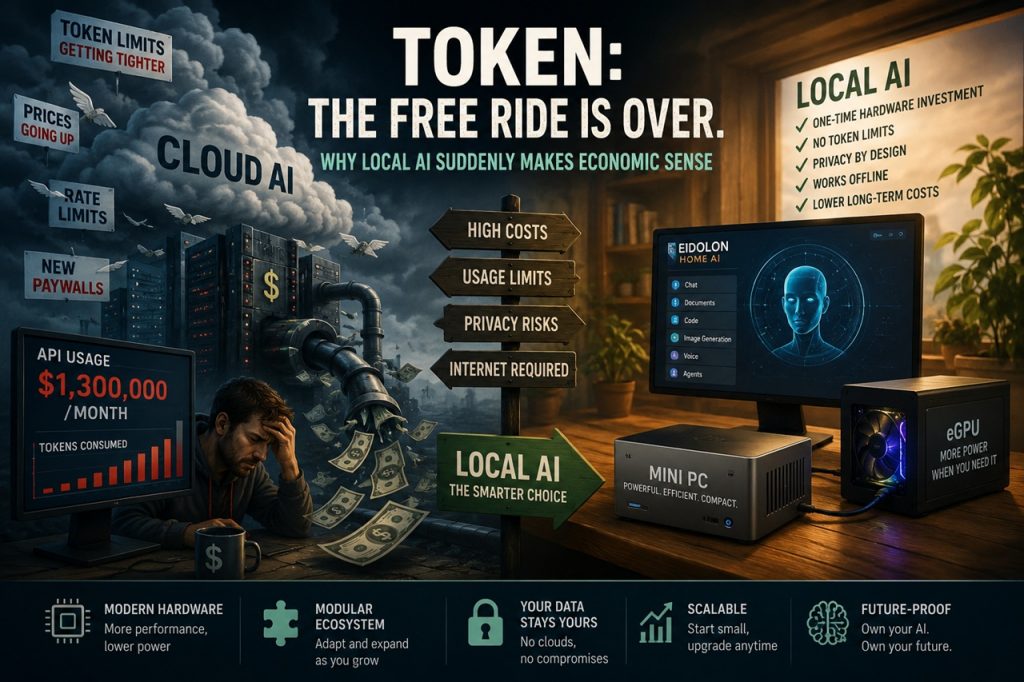
Why Local AI Suddenly Makes Economic Sense? For years, the AI industry trained users to think of generative AI as something almost magical: infinite intelligence, instant answers, endless coding help, image generation, reasoning, research, automation… often for free, or close enough to free that nobody really thought about the cost.
That phase is ending.
Quietly at first. Then all at once. The usual Silicon Valley pattern: subsidize aggressively, create dependency, then start tightening the valves once the ecosystem becomes unavoidable. Even Zeus News recently summarized the situation with brutal simplicity: “Token, è finita la pacchia!” (“The free ride is over.”).
And honestly? It was predictable.
The Hidden Economics of AI
Running frontier AI models is absurdly expensive.
Not “a bit costly.” Not “startup expensive.”
We’re talking about industrial-scale infrastructure costs involving:
- massive GPU clusters,
- power consumption,
- cooling,
- storage,
- networking,
- redundancy,
- and increasingly insane token usage from autonomous agents.
A recent case became almost symbolic: the creator of OpenClaw revealed that a single month of heavy AI-agent usage consumed the equivalent of $1.3 million in OpenAI API tokens across hundreds of billions of tokens and millions of requests.
That example is extreme, obviously. Most users are not running 100 autonomous coding agents like caffeinated techno-necromancers.
But it exposed something important: modern AI workflows consume vastly more compute than traditional chatbot usage.
And that changes everything.
The Era of “Unlimited” AI Is Ending
The signs are everywhere now.
Google is restructuring Gemini usage around compute consumption instead of simple prompt counts, meaning heavy tasks burn through quotas much faster.
At the same time, Google introduced increasingly expensive premium AI plans, including subscriptions reaching $100-$200 per month for advanced access and higher limits.
Even free-tier Gemini access has become more restrictive over time, with tighter rate limits and paywall segmentation around advanced models.
Anthropic, meanwhile, has been increasingly aggressive toward external systems and unofficial toolchains attempting to optimize or bypass Claude-related API consumption.
OpenAI pricing continues evolving as well, with frontier reasoning and multimodal models carrying dramatically higher token costs than lightweight variants.
None of this is irrational. AI inference is expensive. Researchers are increasingly framing modern AI as an “energy-to-token production” problem rather than just a software problem.
The problem is that users got used to the illusion that advanced AI could remain effectively infinite and cheap forever.
It can’t.
AI Agents Change the Cost Equation Completely
This is the part many users still underestimate.
A normal chatbot conversation is relatively cheap.
But modern AI ecosystems increasingly involve:
- autonomous agents,
- coding assistants,
- memory systems,
- multimodal pipelines,
- document analysis,
- tool orchestration,
- continuous context injection,
- validation passes,
- chain-of-thought reasoning,
- and long-running workflows.
Research published this year found that agentic coding tasks can consume up to 1000x more tokens than standard chat or reasoning tasks.
And that matters.
Because once AI becomes part of your daily workflow, subscription costs and token bills stop feeling abstract very quickly.
This Is Why Local AI Suddenly Makes Sense
Local AI is not “free.”
You still need hardware.
But the economic model is fundamentally different.
With cloud AI:
- you pay continuously,
- usage grows over time,
- limits tighten,
- costs scale with activity.
With local AI:
- the hardware is the main investment,
- the marginal cost of usage becomes dramatically lower,
- and you stop thinking in tokens every time you open a conversation.
That changes user psychology completely.
A local AI system can run:
- chat,
- coding,
- voice interaction,
- document analysis,
- memory systems,
- automation,
- image generation,
- and even multimodal workflows,
without a meter constantly running in the background.
And modern local models are no longer toys.
In many real-world tasks, quantized local models now offer performance that is more than sufficient for:
- developers,
- creators,
- researchers,
- writers,
- small businesses,
- home automation,
- and offline personal assistants.
Local AI Hardware Is Also Becoming More Accessible
A lot of people still imagine local AI as requiring a giant RGB gaming tower consuming enough electricity to alert nearby satellites.
That’s outdated.
Today there are surprisingly compact and affordable systems capable of running advanced local AI workloads.
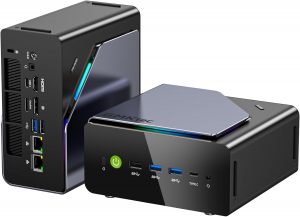
Mini PCs in particular are becoming extremely interesting because:
- they consume less power,
- occupy little space,
- often support high-speed DDR5 shared memory,
- and some models now include OCuLink ports for external GPUs.
This means users can start small and later connect a desktop-class GPU externally.
Some examples currently available include:
- the GMKtec K12 Mini PC Gaming Oculink AMD Ryzen 7 H 255, a compact Ryzen-based mini PC with OCuLink support and Radeon 780M graphics;
- the Apple MAC MINI M4, which has become surprisingly popular among local AI enthusiasts thanks to Apple Silicon unified memory;
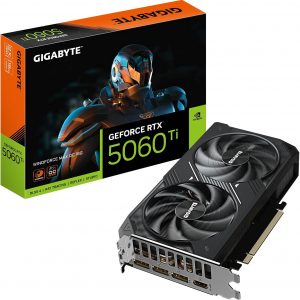
- and GPUs like the Gigabyte GeForce RTX 5060 Ti WINDFORCE MAX OC, which offer enough VRAM for many modern local AI workflows.

The important shift is this: local AI hardware is no longer limited to enthusiasts building massive workstations.
There are now scalable entry points.
The Return of Personal Computing
There’s also something historically familiar happening here.
The industry started with centralized computing:
- mainframes,
- terminals,
- remote access.
Then personal computers decentralized computing power.
Cloud computing centralized it again.
Now AI may be pushing users back toward personal computing once more.
Not because cloud AI will disappear. It won’t.
Cloud models will remain important for:
- frontier reasoning,
- huge multimodal systems,
- enterprise-scale orchestration,
- and tasks requiring enormous infrastructure.
But increasingly, users are discovering that:
having your own local AI stack offers economic predictability, privacy, flexibility, and independence.
And once you experience an AI system that:
- works offline,
- remembers locally,
- runs on your own hardware,
- and doesn’t charge you every time you think,
the appeal becomes very hard to ignore.
Potresti trovare interessante: Eidolon Chat – Full AI chat: multiple personalities, persistent memory, computer vision, document analysis, PIF, internet search, and voice interaction. All local.
The Real Problem Isn’t the Models. It’s Installation.
Of course, there’s a catch. Local AI still has a serious usability problem: Drivers. CUDA. ROCm. Vulkan. Python environments. cuBLAS errors. Dependency hell. Broken libraries. Antivirus false positives. VRAM limitations. Windows updates deciding today is the perfect day to destroy your inference stack.
The average user does not want to spend six hours debugging missing DLLs while questioning their life choices.
And this is exactly where the next generation of local AI ecosystems becomes important:
not just providing models, but making the entire experience installable, usable, and maintainable.
Because in the end, the real competition is not OpenAI, Anthropic, or Google.
It’s complexity itself.