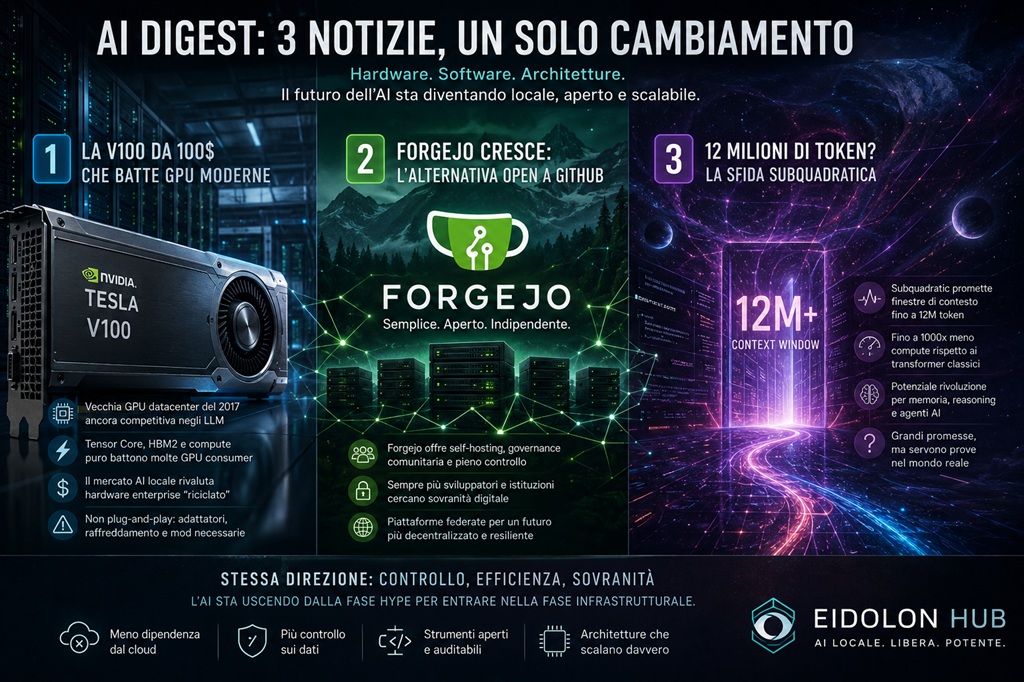
Over the past few days, three seemingly unrelated stories have emerged from the tech world.
An eight-year-old NVIDIA datacenter GPU outperforming modern consumer cards in LLM workloads.
An open-source GitHub alternative rapidly gaining traction.
A startup claiming it can scale AI context windows to 12 million tokens using a new “subquadratic” architecture.
At first glance, these stories appear disconnected.
In reality, they all point toward the same underlying transformation:
the AI industry is slowly moving beyond its hype-driven phase and entering a new era focused on infrastructure, efficiency, decentralization, and sustainability.
Because after years of explosive growth, the AI world is beginning to collide with its real limitations:
- computational cost,
- hardware bottlenecks,
- centralization,
- memory scaling,
- and long-term sustainability.
And the market is starting to react.
1. The $100 NVIDIA Tesla V100 That Still Crushes Modern GPUs in AI
A recent report from Wccftech highlighted something many local AI enthusiasts have quietly known for a while:
old enterprise GPUs can still be incredibly powerful for AI inference.
The NVIDIA Tesla V100, released back in 2017, reportedly outperformed several modern consumer GPUs in specific LLM workloads despite its age.
At first, this sounds absurd.
But it actually reveals an important truth about the current AI hardware landscape.
Modern gaming GPUs are designed to balance:
- gaming performance,
- ray tracing,
- media encoding,
- AI acceleration,
- and power efficiency.
The Tesla V100, on the other hand, was built almost entirely for:
- HPC workloads,
- tensor computation,
- scientific computing,
- and machine learning.
It featured:
- dedicated Tensor Cores,
- extremely high memory bandwidth via HBM2,
- and a compute-focused architecture that still holds up surprisingly well in AI inference.
This does not mean old datacenter hardware is suddenly replacing modern consumer GPUs.
Most used V100 cards come with significant caveats:
- server-oriented cooling requirements,
- high power consumption,
- lack of consumer-friendly outputs,
- uncertain reliability,
- and often years of 24/7 datacenter usage.
Still, the story highlights something extremely important:
the AI era is redefining what makes a GPU valuable.
For years, gaming drove the GPU market.
Now, AI workloads are shifting attention toward:
- VRAM capacity,
- memory bandwidth,
- tensor throughput,
- and inference efficiency.
And this shift is only beginning.
2. Forgejo and the Rise of Decentralized Development Platforms
Another interesting story comes from How-To Geek, which recently explored the rapid growth of Forgejo, an open-source GitHub alternative focused on self-hosting, transparency, and community governance.
Forgejo emerged as a fork of Gitea, itself originally derived from Gogs, after parts of the open-source community became increasingly uncomfortable with commercial centralization and platform control.
Its growing popularity reflects a much broader movement happening across the tech industry:
a push back against excessive centralization.
Over the past decade, platforms like GitHub have evolved from relatively neutral development spaces into massive ecosystem hubs deeply integrated with large corporate infrastructures.
At the same time:
- AI integrations are becoming unavoidable,
- cloud dependency continues to grow,
- and concerns about digital sovereignty are increasing.
Forgejo represents the opposite philosophy:
- self-hosting,
- decentralization,
- auditability,
- community-driven governance,
- and infrastructure independence.
This trend could become particularly important for:
- governments,
- universities,
- privacy-focused organizations,
- open-source communities,
- and AI developers interested in local-first ecosystems.
GitHub is obviously not disappearing anytime soon. Microsoft’s ecosystem dominance remains enormous.
But the growth of projects like Forgejo suggests something important:
the industry is beginning to split ideologically between highly centralized AI-powered ecosystems and smaller, controllable, decentralized infrastructures.
And that divide may become one of the defining themes of the next decade in software development.
3. Subquadratic Claims a 12-Million-Token Context Window
The third story may be the most technically significant of all.
According to The New Stack, startup Subquadratic claims to have developed an architecture capable of scaling AI context windows up to 12 million tokens using a technique called “Selective Sparse Attention.”
If true, this could represent a major breakthrough.
Today’s transformer architectures suffer from a well-known limitation:
attention scaling is quadratic.
This means that as context length increases, computational costs explode exponentially.
The entire modern AI ecosystem has effectively been forced to build workarounds around this limitation:
- Retrieval-Augmented Generation (RAG),
- chunking,
- memory compression,
- external retrieval systems,
- agent routing,
- hierarchical memory structures.
Subquadratic claims its architecture dramatically reduces these scaling costs while maintaining strong retrieval capabilities across enormous contexts.
The implications could be enormous:
- persistent AI memory,
- entire codebases loaded into live context,
- massive multimodal sessions,
- long-form reasoning,
- persistent narrative systems,
- and dramatically more capable AI agents.
However, skepticism is absolutely warranted.
The AI industry has become notorious for:
- benchmark-driven marketing,
- cherry-picked demonstrations,
- unrealistic lab conditions,
- and claims that fail to translate into real-world workloads.
The key question is not:
“Can the model technically load 12 million tokens?”
The real question is:
“Can it reason effectively across them?”
Because context length alone does not equal intelligence.
A model can technically access enormous amounts of information while still:
- losing coherence,
- suffering attention dilution,
- forgetting critical details,
- or failing at multi-step reasoning.
Still, the broader trend is undeniable.
The industry is increasingly searching for alternatives to the traditional transformer architecture:
- sparse attention systems,
- recurrent transformers,
- state-space models,
- Mamba-like architectures,
- hybrid memory systems,
- and retrieval-native AI designs.
The era of “pure transformer dominance” may already be starting to fade.
Conclusion: AI Is Entering Its Infrastructure Era
These three stories may appear unrelated:
- recycled enterprise GPUs,
- decentralized software platforms,
- and experimental AI architectures.
But together, they reveal something much larger.
The AI industry is beginning to transition away from its early hype cycle and into a more mature phase centered around:
- efficiency,
- sustainability,
- scalability,
- local control,
- and infrastructure realism.
That transition matters.
Because the future of AI will not be defined solely by larger models or more impressive demos.
It will depend on whether AI systems can become:
- economically sustainable,
- technically scalable,
- infrastructure-friendly,
- privacy-conscious,
- and usable outside hyperscale cloud environments.
And increasingly, developers, researchers, and users alike are starting to realize that the future of AI may belong not only to massive centralized platforms, but also to smaller, modular, decentralized ecosystems designed around user control and local computation.
The next phase of AI may not simply be “bigger.”
It may be smarter about where intelligence lives, how it scales, and who ultimately controls it.