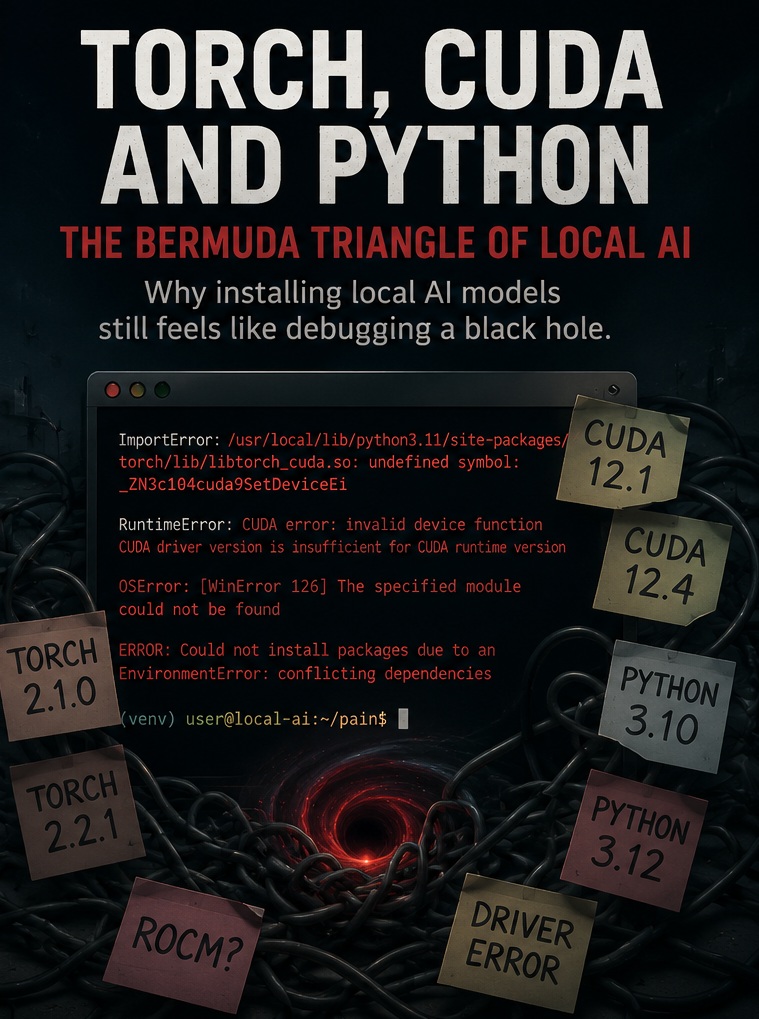
Local AI is evolving at an incredible pace. Every week brings new models, new inference engines, new optimizations and new promises about running advanced AI directly on consumer hardware.
Then someone installs PyTorch.
And suddenly the future collapses into dependency conflicts, CUDA mismatches, broken virtual environments and a terminal window that looks like it is trying to communicate distress signals from another dimension.
The truth is simple: running local AI today is not just about downloading a model. It is about surviving one of the most fragmented software ecosystems modern computing has produced.
The Dream
The dream of local AI sounds beautifully simple:
- Install Python
- Download a model
- Launch the software
- Talk to your AI offline
In theory, modern hardware is finally capable of doing exactly that.
Consumer GPUs can run surprisingly capable models. Quantization techniques such as GGUF have dramatically reduced memory requirements. Inference engines like llama.cpp have made local AI faster and more accessible than ever before.
But then reality arrives.
The Reality
A typical local AI installation can quickly turn into:
- CUDA version conflicts
- Unsupported GPU drivers
- Broken Torch dependencies
- Python version incompatibilities
- Missing DLLs
- ROCm instability
- VRAM detection failures
- Libraries compiled against completely different runtime environments
Sometimes updating a single package is enough to break an entire working pipeline.
And the worst part is that none of this necessarily means the user did anything wrong.
Why Is This Happening?
Because the local AI ecosystem is evolving faster than the software infrastructure around it.
Every major component moves independently:
- PyTorch
- CUDA
- ROCm
- ONNX
- TensorRT
- Transformers
- llama.cpp
- GPU drivers
- inference frameworks
Each project evolves on its own timeline, often optimized for entirely different hardware targets.
One library expects CUDA 12.1.
Another was compiled for CUDA 12.4.
One project supports Python 3.10.
Another silently assumes Python 3.12.
Meanwhile, the user simply wants the GPU to stop pretending it does not exist.
Python: The Beautiful Disaster
Python became the dominant language of AI for good reasons:
- fast development;
- massive ecosystem;
- simplicity;
- accessibility.
But that same ecosystem has become increasingly fragile under the pressure of modern AI workloads.
Many AI repositories behave as if they are the only software package installed on the machine:
- highly specific dependencies;
- rigid version requirements;
- temporary patches;
- experimental builds;
- conflicting runtime assumptions.
The result is an environment where multiple AI tools often cannot peacefully coexist without extensive manual configuration.
Modern local AI setups sometimes feel less like installing software and more like maintaining a research laboratory assembled from incompatible spare parts.
The Real Problem
The biggest obstacle to local AI adoption is no longer model quality.
It is usability.
Today, serious local AI still requires:
- technical knowledge;
- terminal familiarity;
- dependency management;
- hardware troubleshooting;
- environment isolation;
- patience.
A lot of patience.
The average user does not want to spend an entire weekend debugging Torch installations just to run a chatbot locally.
And honestly, they should not have to.
Things Are Improving
Despite the chaos, progress is happening remarkably fast.
Technologies like:
- GGUF;
- llama.cpp;
- containerized runtimes;
- optimized inference engines;
- AI-focused hardware;
- integrated NPUs;
- unified memory architectures;
are making local AI dramatically more practical than it was even a year ago.
The ecosystem is slowly moving toward:
- simpler installers;
- hardware-aware runtimes;
- portable model formats;
- reduced dependency complexity.
The current phase resembles the early personal computer era:
powerful, exciting, revolutionary and often absurdly complicated.
The Next Phase of Local AI
The companies that will shape the future of personal AI may not necessarily be the ones building the biggest models. They may be the ones that solve the software fragmentation problem.
Because most users do not care about CUDA versions, Torch wheels or Python environments.
They care about whether the AI works.
And right now, the difference between “AI for enthusiasts” and “AI for everyone” is still hidden somewhere inside a dependency resolver error message.