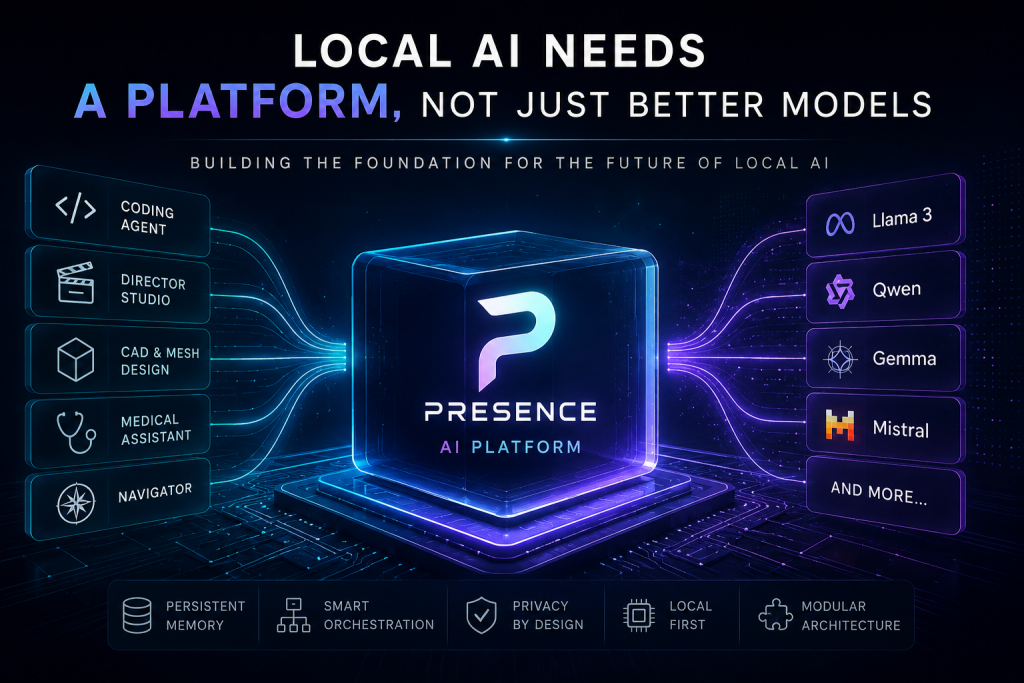
Local AI is evolving at an incredible pace. Every few months a new language model appears, promising better reasoning, stronger coding abilities, improved vision or faster inference. The conversation usually revolves around which model is currently the best, but that question may actually be less important than many people think.
The real challenge is not choosing today’s best model. The real challenge is building a system that can still take advantage of tomorrow’s model without having to redesign everything from scratch.
This is the philosophy behind Presence.
One of the most common misconceptions surrounding local AI is that the language model is the application itself. In reality, a model is much closer to an engine than to a finished product. It can generate text, analyze images or write code, but it knows nothing about persistent memory, workflow management, hardware optimization, user permissions or the interaction between different specialized tools.
Those responsibilities belong to the platform.
For years we’ve become accustomed to judging AI software by the model it includes. “Does it use Llama?” “Is it running Gemma?” “Can it load Qwen?” These are reasonable questions, but they are becoming less relevant as open-source models improve at an astonishing speed.
A model that represents the state of the art today may be surpassed in six months. If the entire application depends on that specific model, every major advancement becomes a migration problem.
A platform approaches the problem differently.
Presence has been designed as the environment in which specialized AI models operate. The language model is only one component inside a much larger architecture that handles everything around it. Memory, orchestration, routing, hardware management and specialized modules continue to exist regardless of which model is currently providing the reasoning.
This separation offers a degree of flexibility that becomes more valuable every time a new model is released.
If tomorrow a better coding model appears, the Coding Agent can adopt it.
If a new vision model produces better image understanding, it can replace the previous one.
If a faster reasoning model becomes available for consumer hardware, the platform can integrate it without changing the user’s workflow.
The important part is that users keep working exactly as before while the underlying technology continues to evolve.
This is very similar to the way modern operating systems have always worked.
Nobody buys Windows because it includes Notepad. Nobody installs Linux because of a single application. The operating system provides services, manages resources and allows thousands of different programs to coexist. Applications come and go, hardware changes, processors become faster, but the platform remains the foundation that allows everything else to work together.
Local AI is moving toward the same destination.
As AI systems become more specialized, a single language model will no longer be expected to perform every possible task. Different models excel at different jobs. Some are outstanding programmers, others are better writers, others generate images, reason over scientific papers or analyze medical information more effectively.
Instead of forcing one model to do everything, it makes more sense to let each specialized component perform the task it does best while a common platform coordinates the entire workflow.
This is one of the reasons why Presence is built around modules rather than around a single monolithic assistant. The Coding Agent, Director Studio, CAD tools, image generation, workflow automation and future modules all share the same infrastructure while remaining largely independent of the specific model running underneath.
As better open-source models become available, those modules can evolve with them.
In the long run, this may prove to be far more important than winning today’s benchmark comparisons.
Benchmarks measure the quality of individual models at a specific moment in time. Platforms determine how easily an entire ecosystem can benefit from every improvement that comes afterward.
The open-source AI community is moving extraordinarily fast. New architectures appear constantly, quantization techniques improve, inference engines become more efficient and consumer hardware grows more capable every year. Trying to predict which model will dominate two years from now is probably impossible.
Designing a platform that can adapt to whichever model becomes dominant is a much more realistic strategy.
Presence was conceived with exactly that goal in mind. Rather than being tied to a single AI model, it is designed to become the environment where future local AI technologies can be integrated, combined and expanded over time.
Ultimately, software ages. Platforms evolve.
And in a field moving as quickly as local AI, evolution is likely to be the feature that matters most.