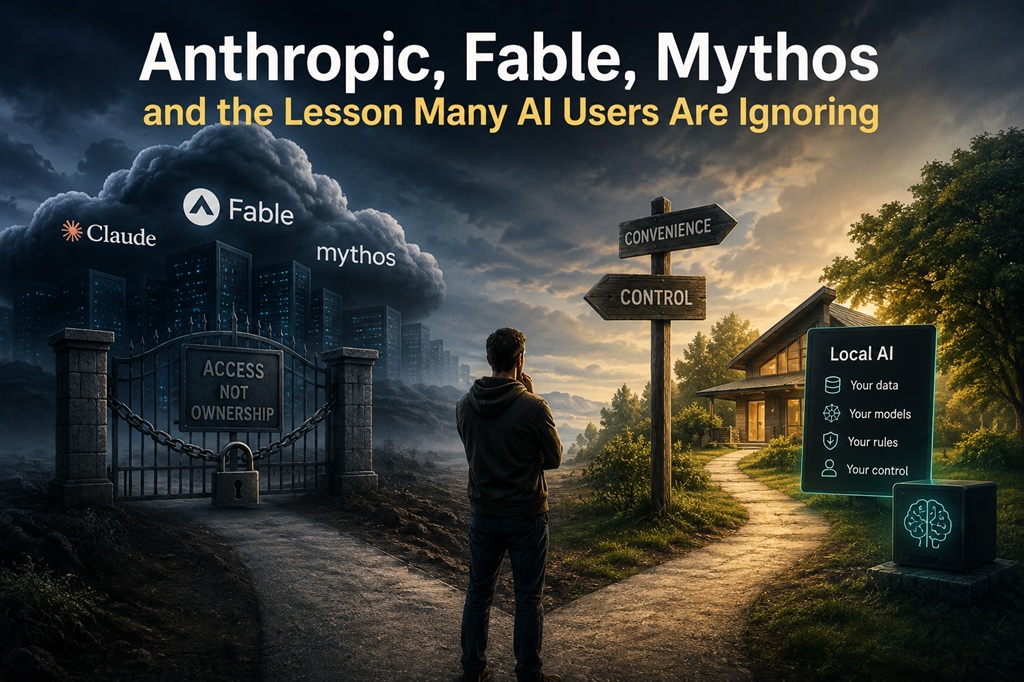
In recent days, the debate has focused on the confrontation between Anthropic and the U.S. administration. Discussions have revolved around national security, export controls, access to advanced AI models and the relationship between governments and technology companies. These are important issues, but they risk distracting us from what is arguably the most interesting question of all.
This is not really about Anthropic.
It is not about Trump.
It is not even about artificial intelligence.
It is about control.
Many users have suddenly discovered that access to a tool they use every day can be restricted, modified or revoked by a decision made by someone else.
Even if they paid for it.
Even if they have an active subscription.
Even if they have been using the service for months or years.
We have written this before in other contexts: when we use a cloud service, we do not actually own the tool. We merely hold a temporary licence to access it under conditions established by the provider.
And that distinction matters.
A subscription is not ownership, just as an account is not control, and a licence is not technological sovereignty.
The history of computing is full of similar examples: services shut down, features removed, prices changed, APIs discontinued, entire products abandoned.
Almost always without consulting the users who depend on them, leaving them with no real way to recover what has been lost.
In the world of artificial intelligence, the problem is even more evident because these tools are becoming an integral part of the daily work of millions of people.
Writers, researchers, programmers, designers, students and professionals of every kind increasingly depend on AI models running on servers controlled by third parties.
As long as everything works, the system appears convenient and efficient. The problems begin when the rules change, often without warning, and users suddenly discover that they have no real control over a technology on which they have become dependent.
This does not mean that the cloud is inherently bad, nor that it is destined to disappear or become the exclusive domain of governments and large corporations powerful enough to make themselves heard. Nor does it mean that online services are useless.
What it does mean is that there is a fundamental difference between using a tool and owning it. There is a difference between being the owner of your data and your work and merely being its creator. There is a difference between storing everything on infrastructure managed by someone else and keeping it on a machine that you own, control and manage yourself.
It is precisely this awareness that is driving the growing interest in local AI solutions.
A model installed on your own computer may be less powerful. In fact, it almost certainly is. It often requires dedicated hardware and continuous updates to keep pace with innovation.
Yet it has one unique characteristic: it continues to work even when someone else’s corporate policies change, when commercial conditions shift, or when governments make decisions that affect access to technology.
Many people will probably remember the Anthropic controversy for political reasons.
For private citizens and small and medium-sized businesses affected by its consequences, however, the most important lesson may be a very different one.
When a technology becomes essential to your work or your digital life, it is worth asking yourself a simple question:
Are you merely using it?
Or do you actually control it?