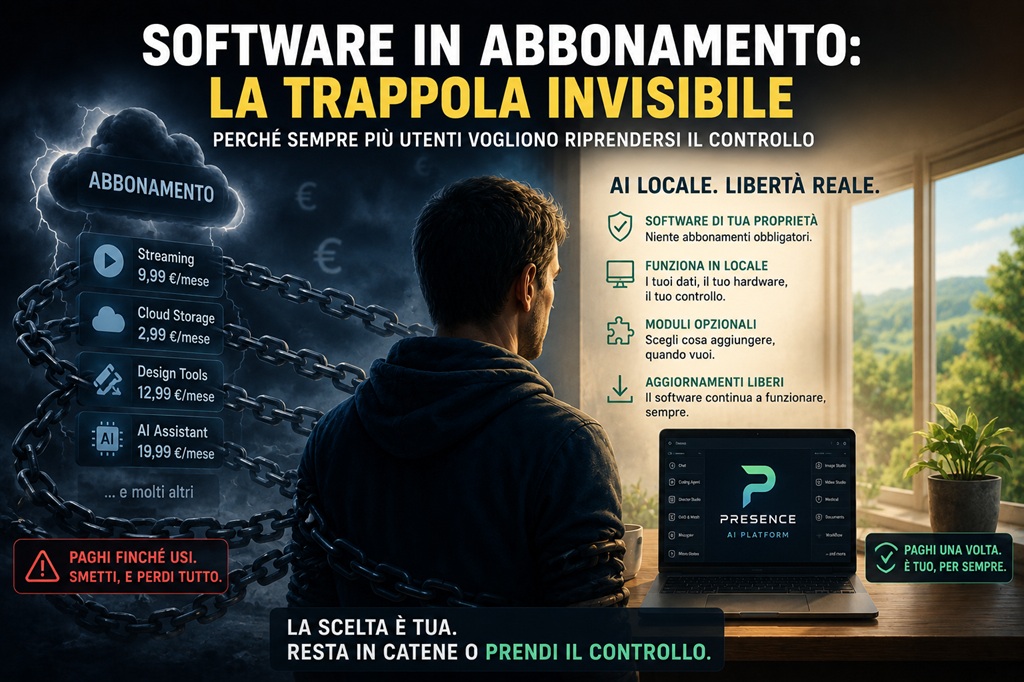
Artificial intelligence is changing the software industry at an astonishing pace. Every week brings a new language model, a more capable coding assistant, a faster image generator or another AI service promising to transform the way we work.
There’s just one detail that many users are beginning to question.
Why does almost everything require another monthly subscription?
The subscription model is not inherently bad. For many online services it makes perfect sense. Running cloud infrastructure, maintaining massive GPU clusters, storing user data and providing APIs all generate continuous costs. Companies need recurring revenue to keep those services alive.
The problem begins when that same business model is applied everywhere, even when it no longer reflects how the software actually works.
Local AI changes the equation.
When a language model runs on your own computer, the processing power comes from your CPU and GPU. The memory belongs to your machine. The electricity is yours. In many cases, the software isn’t consuming expensive cloud resources every time you ask a question or generate an image.
Naturally, many users start asking a simple question.
If I’m providing the hardware, why am I paying forever just to keep using software I’ve already purchased?
This isn’t really about saving a few dollars every month.
It’s about ownership.
For decades, buying software meant exactly that. You purchased a license, installed the application and decided for yourself if and when you wanted to upgrade. New versions offered new features, but the version you already owned continued to work.
That simple relationship has gradually disappeared.
Today it’s common to see software that stops working the moment a subscription expires. Files remain inaccessible, advanced features are disabled and sometimes even projects created by the user become difficult to access without renewing the license.
The feeling many users describe isn’t that they’re buying software anymore.
It’s that they’re renting permission to work.
Artificial intelligence has amplified this phenomenon.
A designer may subscribe to an image generator.
A programmer pays for a coding assistant.
A writer subscribes to another language model.
Then come cloud storage, video editing, productivity tools, research assistants and countless premium AI services.
Individually, none of these subscriptions look particularly expensive.
Together, they often become one of the largest recurring technology expenses many professionals face every year.
That is one of the reasons why local AI has attracted so much attention over the past two years.
Performance and privacy certainly matter, but there is another advantage that is often overlooked.
Control.
When AI runs locally, users regain something they have gradually lost: the ability to decide how long their software remains useful.
That doesn’t mean software should never evolve.
Quite the opposite.
New models will continue to appear. Better image generators will be released. Coding assistants will improve. Specialized AI agents will become increasingly capable.
The important difference is that users should decide whether they want those new capabilities.
Not because their existing software suddenly stopped working, but because the new features are genuinely valuable.
This distinction may seem subtle, yet it fundamentally changes the relationship between developers and customers.
Instead of locking users into an endless payment cycle, developers earn future purchases by continuing to improve their products.
That creates a healthier incentive for everyone involved.
This philosophy is one of the foundations behind Presence.
Presence, when you own your software
Presence is designed to run locally, using your own hardware and your own AI models. Future modules and specialized agents will expand what the platform can do, but they won’t turn existing functionality into a subscription requirement.
If you decide a new module is useful, you can add it.
If you don’t, the software you already own continues to work exactly as before.
We believe that’s how local AI should evolve.
Not by forcing users into increasingly complex subscription ecosystems, but by giving them the freedom to expand their tools only when they genuinely see value in doing so.
After all, you already bought the hardware.
Perhaps it’s time software started behaving like something you can actually own again.