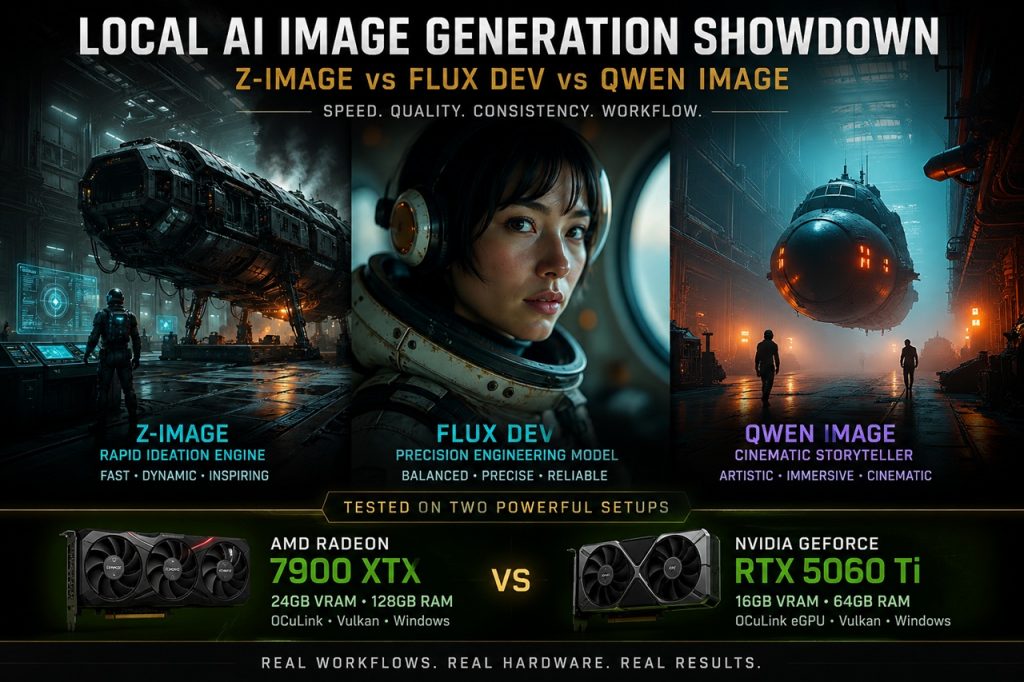
Real-world tests. Real prompts. Real hardware. No datacenter fantasy setups.
The Local AI Landscape Has Changed
For years, local AI image generation was treated like a niche playground for enthusiasts with expensive workstations, huge power supplies, and enough VRAM to heat a small apartment.
That reality is changing very quickly.
Modern optimized image models, improved Vulkan backends, smarter memory management and increasingly efficient inference pipelines are making serious local AI workflows possible even on compact consumer hardware.
To explore how far things have evolved, we compared three very different image generation models using the same prompts and resolutions across two real-world systems:
- AMD Radeon RX 7900 XTX 24GB VRAM + 128GB RAM
- NVIDIA RTX 5060 Ti 16GB VRAM connected through OCuLink to a compact miniPC with 32GB RAM
The goal was not to chase synthetic benchmarks.
Instead, we focused on:
- creative workflow usability
- image quality
- consistency
- artistic personality
- real generation times
- practical local AI experience
And honestly?
The results were far more interesting than expected.
The Tested Models
Z-Image
Z-Image surprised us immediately.
It is fast. Extremely fast.
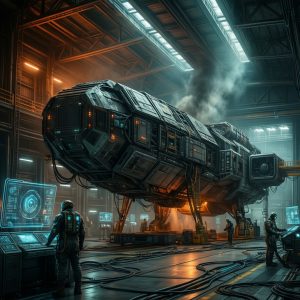
But unlike many lightweight models, it does not simply trade speed for low quality. Instead, it produces atmospheric cinematic science fiction imagery with a remarkable sense of mood and visual energy.


Its strongest qualities:
- rapid ideation
- industrial sci-fi atmosphere
- strong cinematic lighting
- excellent speed-to-quality ratio
- creative iteration workflow
Z-Image feels like a tireless concept artist constantly generating ideas.
FLUX Dev
FLUX Dev quickly emerged as the most balanced model in the comparison.
It combines:
- high visual consistency
- excellent anatomy
- impressive material rendering
- strong spatial coherence
- realistic lighting
- manageable generation times
FLUX often feels less “dreamlike” than Qwen Image and less spontaneous than Z-Image, but it consistently produces polished, professional-looking results.
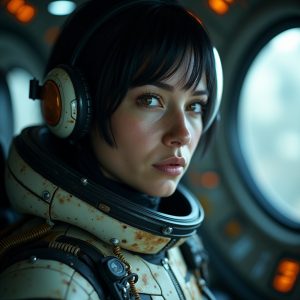
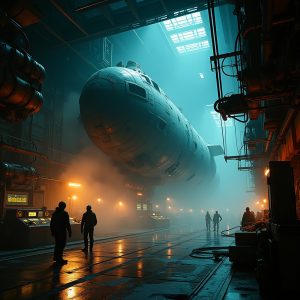
Its strengths became especially visible in:
- portraits
- industrial environments
- cinematic sci-fi architecture
- realistic textures
- production-design style scenes
If Z-Image feels like rapid concept art generation, FLUX Dev feels like a professional production pipeline.
Qwen Image
Qwen Image was already known for its cinematic qualities, but comparing it directly against the others highlighted both its strengths and its costs.
Qwen excels at:
- visual storytelling
- emotional framing
- cinematic composition
- premium character rendering
- editorial-style imagery

The model often produces images that feel less like generated art and more like frames extracted from a high-budget science fiction film.
However, this quality comes with a significant computational cost.
Generation times were dramatically higher than both Z-Image and FLUX Dev.
Qwen is clearly designed for:
- deliberate final renders
- premium artwork
- cinematic storytelling
- high-end visual refinement
rather than rapid iterative workflows.
Test Methodology
The comparison focused on two recurring scenarios:
1. Cinematic Spacecraft Cockpit Portraits
Designed to stress:
- human anatomy
- skin texture
- eyes
- reflections
- cockpit lighting
- hands
- shallow depth of field
- cinematic framing
2. Massive Industrial Spacecraft Hangars
Designed to stress:
- large-scale geometry
- environmental coherence
- lighting complexity
- metallic surfaces
- volumetric atmosphere
- spatial depth
- industrial detail
All tests used:
- identical prompts
- identical negative prompts
- fixed workflow structure
- matching resolutions
The focus was not strict scientific benchmarking, but practical creator-oriented comparison.
Results on Radeon RX 7900 XTX
Z-Image
512×512
Approximately 15 seconds
1024×1024
Approximately 49 seconds
Impressions
Z-Image delivered astonishing speed while preserving surprisingly high-quality cinematic atmosphere.
Its industrial sci-fi scenes were especially impressive.
The model consistently produced:
- dramatic volumetric lighting
- believable metallic environments
- cinematic mood
- coherent visual style
Despite being the fastest model tested, it never felt “cheap.”
Instead, it felt energetic.
The experience encouraged experimentation and rapid iteration.
FLUX Dev
512×512
Approximately 28 seconds
1024×1024
Approximately 48–88 seconds depending on scene complexity
Impressions
FLUX Dev emerged as the most balanced overall model.
Its portrait rendering was exceptional:
- highly detailed skin
- realistic eyes
- believable materials
- excellent facial consistency
- strong hand anatomy
The industrial hangar scenes were equally impressive.
FLUX handled:
- scale
- depth
- architecture
- lighting coherence
- environmental realism
with remarkable consistency.
The model produced images that genuinely resembled professional sci-fi production design.
Qwen Image
512×512
Approximately 46–69 seconds
1024×1024
Approximately 249–286 seconds
Impressions
Qwen Image delivered the most cinematic results of the entire comparison.
Its strengths were obvious in:
- framing
- emotional composition
- storytelling atmosphere
- portrait realism
- visual narrative coherence
Some images genuinely resembled film stills.
However, the computational cost was enormous.
At 1024×1024, generation times entered multi-minute territory.
Qwen clearly prioritizes visual refinement over rapid workflow usability.
Results on RTX 5060 Ti 16GB via OCuLink
One of the biggest surprises of the comparison came from the compact miniPC setup.
The system used:
- RTX 5060 Ti 16GB
- external GPU connection via OCuLink
- compact miniPC platform
- 32GB RAM
Conventional internet wisdom would suggest a severe performance penalty compared to the 7900 XTX workstation.
Reality was far more nuanced.
At lower resolutions, the AMD system maintained a clear lead.
However, at higher resolutions and more complex workloads, the gap often became surprisingly small.
In some scenarios:
- the RTX 5060 Ti remained highly competitive
- memory management became more important than raw VRAM size
- workload scaling mattered more than synthetic specifications
Most importantly:
the miniPC setup remained fully usable for serious local AI creation.
That may ultimately be the most important takeaway of the entire experiment.
What We Learned
1. There Is No Single “Best” Model
Each model developed a clear creative identity.
Z-Image
Rapid ideation and atmosphere.
FLUX Dev
Professional balance and consistency.
Qwen Image
Cinematic storytelling and premium visual direction.
Rather than competing directly, the models complement one another.
2. Workflow Matters More Than Raw Benchmarks
The most interesting discovery was not absolute speed.
It was:
- how enjoyable each model felt to use
- how naturally they supported creative iteration
- how well they matched different artistic intentions
Creators do not think in FLOPS.
They think in outcomes.
3. Local AI Is Now Creatively Viable
This is perhaps the biggest conclusion.
All three models generated:
- high-quality cinematic science fiction imagery
- realistic portraits
- complex industrial environments
- coherent atmospheric scenes
entirely locally.
No cloud rendering. No subscriptions. No remote GPU farms.
This is no longer experimental technology.
It is a real creative workflow.
4. 16GB VRAM Is More Important Than Many People Realize
The tests strongly suggest that modern optimized pipelines can achieve remarkable results with:
- 16GB VRAM
- efficient memory handling
- optimized backends
- balanced system architecture
The difference between 16GB and 24GB was often far smaller than expected during real-world workflows.
This has major implications for the future of consumer local AI.
The Future Is Orchestrated Creativity
Perhaps the most interesting insight is this:
The future of local AI creation may not belong to a single universal model.
Instead, it may belong to orchestrated ecosystems.
Different models excel at different creative intentions.
Imagine a future AI hub where users choose:
- Rapid Concept Mode
- Cinematic Storytelling Mode
- Production Design Mode
- Professional Portrait Mode
rather than manually selecting model architectures.
That future suddenly feels very close.
And after these tests, it is difficult not to believe that local AI creative ecosystems are about to become dramatically more important over the next few years.
Final Thoughts
The most surprising part of this entire comparison was not speed.
It was quality.
Even relatively accessible hardware configurations can now produce:
- cinematic science fiction imagery
- believable characters
- complex environments
- production-quality visual concepts
completely locally.
That would have sounded unrealistic not long ago.
Now it feels inevitable.
And honestly?
That may be the most exciting result of all.