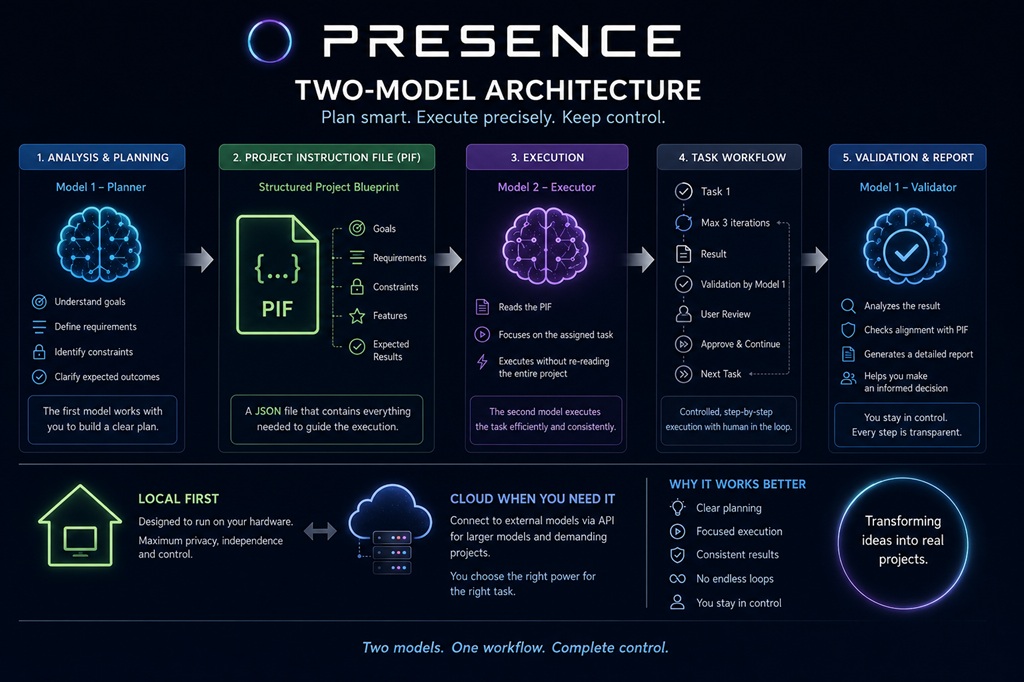
One of the questions we receive most often concerns the internal workings of Presence’s agentic modules.
Many AI systems today rely on a single conversation: the user provides a request, and the model attempts to analyze it, remember the requirements, make decisions, and generate the final result, all within the same context.
This approach works well for simple tasks, but it tends to show its limitations when dealing with complex projects, especially in software development, structured writing, or advanced content generation.
For this reason, we developed a two-model architecture that separates the planning phase from the execution phase.
The First Model: Analysis and Planning
When a user starts a project, the first model works together with them to clearly define:
- project goals;
- functional requirements;
- technical constraints;
- desired features;
- expected outcomes.
At the end of this phase, a PIF (Project Instruction File) is generated. This structured JSON document contains all the information needed to guide the work that follows.
During our testing, we discovered that AI models perform significantly better when they receive precise, structured instructions rather than having to continuously reinterpret long conversations.
The PIF becomes a kind of “project map” that maintains consistency and direction throughout the entire process.
The Second Model: Specialized Execution
Once the PIF has been created, the second model takes over.
Instead of repeatedly rereading and reinterpreting the entire project, this model can focus exclusively on executing the assigned task.
The result is a system that is more efficient, more consistent, and less likely to lose important information during execution.
Breaking Projects into Tasks
Another important feature of Presence’s agentic architecture is the division of work into sequential tasks.
Each task is handled individually and completed before moving on to the next one.
This approach provides several advantages:
- greater control over the process;
- higher quality results;
- the ability to review each stage before continuing;
- reduced accumulation of errors over time.
To prevent infinite loops and unproductive behavior, each task may be repeated a maximum of three times before requiring human evaluation.
Validation and Human Oversight
At the end of every task, the first model reviews the generated result and produces an evaluation report.
The user can then:
- approve the result;
- request modifications;
- stop the process;
- proceed to the next task.
We believe users should always remain at the center of the decision-making process. The goal of Presence is not to replace human judgment, but to amplify human capabilities.
Local First
As many of you already know, Presence has always been built around a local-first philosophy.
The entire architecture is designed to run on users’ own computers, making the best possible use of available resources and adapting to the hardware installed on each system.
Different systems may use different models, automatically selecting the best balance between performance, quality, and hardware requirements.
When More Power Is Needed
Some projects, however, can benefit from models that are far larger than what is typically practical on a consumer computer.
For this reason, Presence’s agentic architecture also supports optional connections to cloud-based AI models through APIs.
This allows users to decide, project by project, whether they want to:
- run everything locally for maximum privacy and independence;
- leverage external cloud models when a task requires greater reasoning capabilities or significantly more computational power.
The choice will always remain in the hands of the user.
Looking Ahead
This architecture represents an important part of our long-term vision.
AI models will continue to evolve rapidly. A model that is considered state-of-the-art today may be surpassed within a matter of months.
For that reason, our goal is not to build Presence around any single model, but around a workflow capable of making the best possible use of both current and future models.
More than a simple AI chat application, Presence aims to become a platform capable of transforming complex ideas into real projects while always keeping users firmly in control.
Thank you for continuing to follow us on this journey.