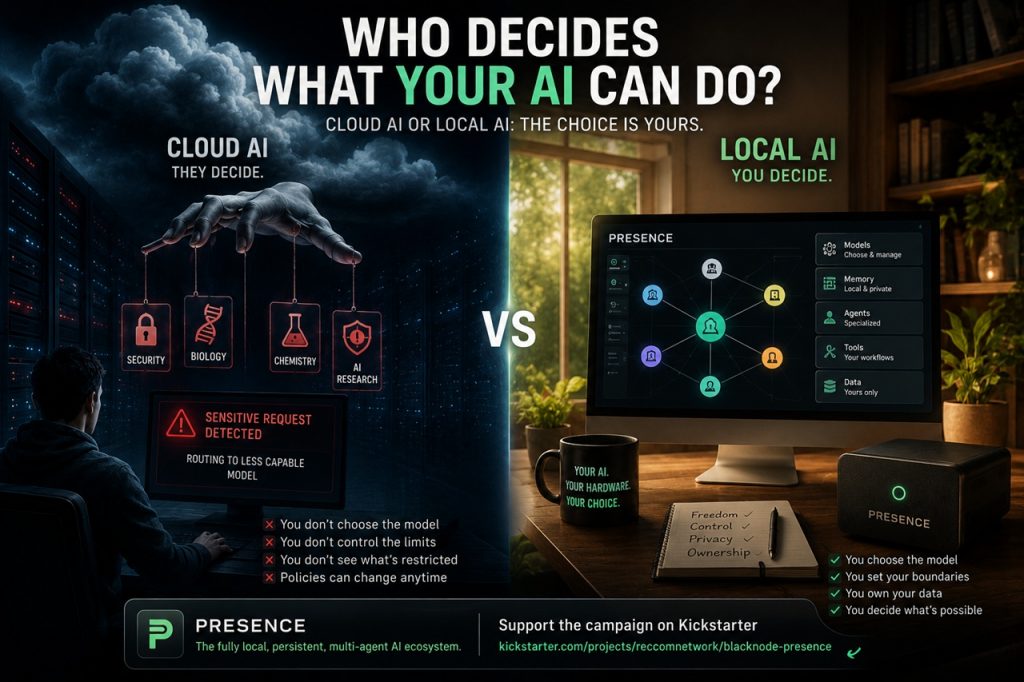
This week, Anthropic released Claude Fable 5, the public version of its new Mythos-class model.
The launch immediately sparked debate.
Not because of what the model can do, but because of what users may not be allowed to do with it.
Anthropic introduced safety systems that can identify certain categories of prompts, particularly around cybersecurity, biology, chemistry, and advanced AI research. When triggered, those requests may be handled differently or routed to less capable models in order to reduce potential misuse. Anthropic argues these measures are necessary because of the capabilities involved.
Reasonable people can agree with that.
The interesting part is not whether the restrictions are justified.
The interesting part is what they reveal about the future of AI.
Cloud AI and Local AI are not merely different deployment models.
They are different philosophies.
When you use a cloud model, you are consuming a service.
The provider decides:
- what model is available;
- what capabilities remain enabled;
- what safeguards exist;
- what changes tomorrow.
When you run AI locally, you own the tool.
You decide:
- which model to install;
- when to upgrade;
- which workflows to build;
- which capabilities matter to you.
For years, advocates of local AI focused on three benefits:
- Privacy
- Cost control
- Independence from cloud infrastructure
A fourth benefit is now becoming impossible to ignore:
Control.
This doesn’t mean local AI is automatically better.
Cloud models remain more powerful in many areas.
But raw model capability is no longer the only variable that matters.
Multi-agent systems, persistent memory, retrieval pipelines, specialized models, and intelligent orchestration are changing the equation.
Instead of relying on a single giant model, local ecosystems increasingly distribute work across multiple specialized components.
The result is not always more intelligence.
Often, it is simply better organization.
For security researchers, OSINT analysts, journalists, educators, and technical professionals, this distinction matters.
Not because they want unrestricted AI.
But because they want to decide for themselves which tools they use.
That is ultimately what local AI offers.
Not perfection.
Not unlimited capability.
Ownership.
And as cloud providers continue adding layers of policy, filtering, classification, and access controls, ownership may become one of the most valuable features an AI system can provide.
Perhaps the future of AI will not be decided solely by benchmark scores.
Perhaps it will also be decided by a much simpler question:
Who controls your AI?
Interested in a fully local, persistent, multi-agent AI ecosystem?
Presence is currently live on Kickstarter:
https://www.kickstarter.com/projects/reccomnetwork/blacknode-presence
Your AI. Your hardware. Your choice.