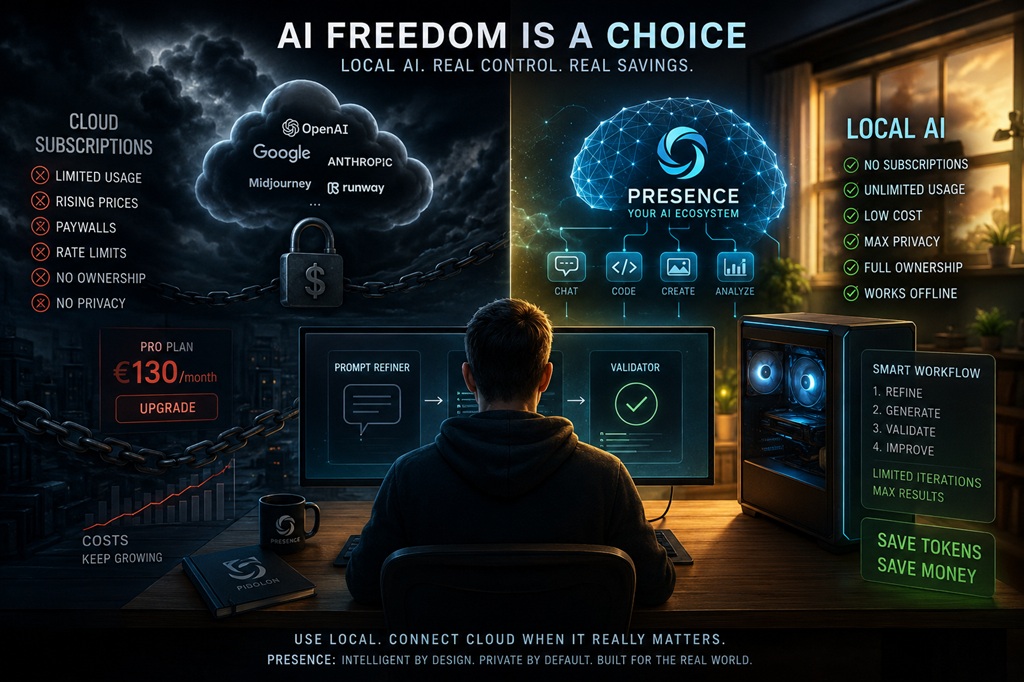
Over the last two years, the AI industry has trained users to think of advanced artificial intelligence as something almost unlimited and nearly free. That phase is ending, today, most major AI providers are rapidly increasing restrictions, usage limits, and subscription costs:
- premium plans are becoming more expensive,
- advanced video and image generation is increasingly paywalled,
- free usage tiers are shrinking,
- API costs remain unpredictable,
- and high-end AI workflows can easily cost hundreds of dollars per month for professional users.
For casual users this may simply be annoying but for developers, creators, researchers, coders, and AI power users, it becomes a real economic problem.
At Blacknode, we believe the future is not “cloud only.”
The future is hybrid.
And in many cases, local AI is becoming the most rational solution.
Why Local AI Matters Now
Modern consumer hardware is already powerful enough to run surprisingly capable AI systems locally.
A well-optimized local language model can:
- generate high-quality code,
- analyze documents,
- assist with writing,
- manage conversations,
- help refine prompts,
- orchestrate workflows,
- and even coordinate specialized AI modules.
The key is not simply model size.
The real breakthrough comes from orchestration.
Instead of relying on a single massive cloud model for everything, Presence uses a layered architecture:
- one model helps refine the task,
- another specialized model executes it,
- a validator model reviews the output,
- and the workflow is kept under controlled iteration limits.
This approach dramatically reduces unnecessary token consumption while improving reliability.
In practical terms:
- fewer hallucinations,
- lower cloud costs,
- faster iteration,
- and far more predictable behavior.
The Presence Approach
The upcoming Presence agent local AI ecosystem is designed around efficiency, privacy, and sustainable AI usage.
Our philosophy is simple:
Use local AI whenever possible.
Use cloud AI only when truly necessary.
For example:
- a local conversational model can help refine prompts,
- a coding model can generate and modify software,
- a validator model can analyze the generated code,
- and only particularly complex tasks may optionally be escalated to larger cloud models through API access.
This hybrid workflow offers a major advantage:
users keep most of the workload local while still retaining access to frontier-level intelligence when needed.
The same logic applies to image and video generation.
Instead of paying cloud services for endless failed attempts, users can:
- iterate locally,
- optimize prompts,
- test compositions,
- refine styles,
- and only use premium cloud generation for the final high-quality render.
This can reduce costs dramatically.
Smarter AI, Not Bigger Bills
The AI industry is moving toward increasingly expensive subscription ecosystems.
Many users now pay separately for:
- chat assistants,
- coding copilots,
- image generators,
- video generators,
- voice systems,
- research assistants,
- and agentic workflows.
The combined monthly cost can quickly become substantial.
Presence is being designed to offer an alternative:
- modular,
- local-first,
- hardware-aware,
- expandable,
- and economically sustainable.
A capable consumer PC equipped with a modern GPU can already handle an impressive percentage of daily AI workflows entirely offline.
And unlike cloud subscriptions:
- your models remain available,
- your workflows remain under your control,
- and your costs do not scale endlessly with usage.
The Return of Ownership
For years, software moved toward fully centralized cloud ecosystems, AI is now exposing the limitations of that model. When your intelligence layer depends entirely on remote services, you are also dependent on:
- pricing changes,
- usage caps,
- feature removals,
- policy shifts,
- queue limits,
- and platform decisions you do not control.
Local AI changes that equation.
Your models live on your hardware.
Your workflows belong to you.
Your tools remain available even without an internet connection.
We believe this is not a temporary trend.
It is the beginning of a much larger shift in how people interact with artificial intelligence.
And Presence is being built for exactly that future.