Cloud AI is convenient. Too convenient.
You type, it answers. No setup, no hardware headaches, no friction.
But that convenience comes at a cost: your data, your prompts, your work — all processed somewhere else, on someone else’s machine.
Local AI flips the equation.
You get privacy. Control. Independence.
But then reality kicks in:
it’s fragmented, messy, and often far more complex than people expect.
And that’s where the real problem begins.
The Real Problem
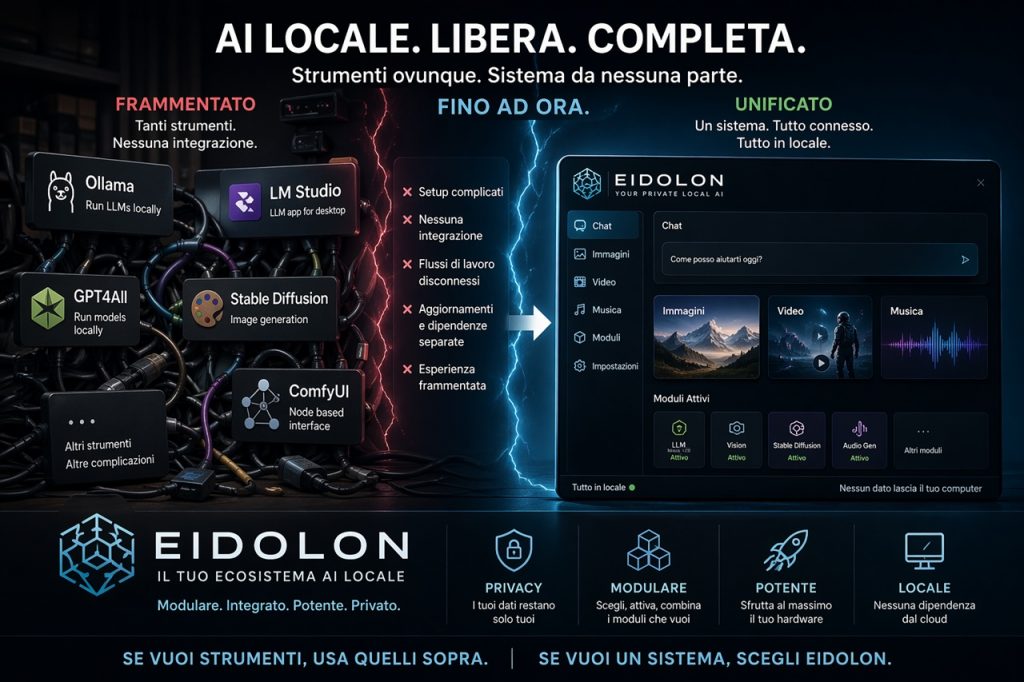
Running AI locally is still fragmented.
Not “a bit inconvenient.” Fragmented.
You don’t get a system.
You get pieces:
- One tool for chat
- Another for images
- Another for video
- Another for music
Each with its own setup, dependencies, quirks, and breaking points.
There is no cohesion.
You spend more time wiring things together than actually using them.
And if something breaks?
Good luck figuring out which layer failed.
The Current Tools (And Their Limits)
Let’s be fair. There are solid tools out there.
- Ollama → clean, simple, great for running models quickly
- LM Studio → user-friendly, especially for beginners
- GPT4All → accessible and lightweight
On the generative side:
- Stable Diffusion → powerful, but requires tuning
- ComfyUI → extremely flexible, borderline chaotic
These tools are not bad.
In fact, they’re impressive.
But they share the same limitation:
They are isolated solutions.
You can run them.
You can even master them.
But you can’t turn them into a coherent system without effort — and often, a lot of it.
The Problem Nobody Solves
None of these tools offer a unified ecosystem.
No shared architecture.
No integrated workflow.
No real sense of continuity between tasks.
You don’t “use AI locally.”
You juggle tools.
And the moment you try to scale — combining chat, image generation, video, automation — everything starts to feel like duct tape.
A Different Approach
What’s missing isn’t another tool.
It’s a system.
A system where:
- Chat, image, video, and music generation coexist
- Modules are designed to work together
- Everything runs locally, but without turning setup into a full-time job
This is where projects like Eidolon Hub take a different path.
Not by reinventing the models —
but by organizing them.
A modular structure.
A unified interface.
A focus on integration instead of fragmentation.
It doesn’t remove complexity entirely.
But it contains it.
Conclusion
If you want tools, you already have excellent options.
Use them. Learn them. Push them.
But if you want a system —
something that behaves like a cohesive environment rather than a collection of parts —
then the conversation changes.
Because at that point, it’s no longer about what each tool can do.
It’s about how everything works together.
And that’s where the real gap still is.